
How decades of travel and observation shaped a photographer’s way of seeing—and why light remains his most trusted guide
For Ira Block, photography began not as a career plan but as a passport.
His approach is deeply rooted in documentary photography lighting, where natural and controlled light work together to shape authentic visual stories.
Long before he had traveled widely, the camera gave him a reason to go—to step outside the familiar rhythms of New York City and encounter the wider world. Photography was the tool that opened the door. The journeys came afterward.
Over the decades that followed, Block would travel extensively, photographing cultures, landscapes, and people across continents. The camera remained constant. It was the thread that carried him into temples, markets, homes, deserts, mountains, and cities far removed from the life he knew growing up.
Yet the deeper change was not geographic. It was perceptual.
Travel and photography gradually dismantled the assumptions that many people carry without noticing. Early encounters with unfamiliar cultures often produced the reflexive comparisons common to Western travelers—judgments about who had more, who had less, who seemed fortunate, who seemed deprived.
Time and proximity altered that thinking.
Living among communities around the world revealed something subtler: people measure fulfillment differently. What appears from a distance to be scarcity may in fact be balance. What seems simple may be deeply rich in ways that are not immediately visible.
That realization changed the way Block photographed people. His images are not interested in spectacle or exoticism. They are interested in presence.
And light—quietly, consistently—became one of the tools that helped him reveal it.

The Mood of an Ira Block Photograph
Many photographers are recognized by a visual signature that calls attention to itself—dramatic contrast, bold color, or a distinctive stylistic flourish.
Ira Block’s signature is quieter.
His photographs carry a sense of atmosphere. The viewer’s attention settles naturally on the person in the frame. The light rarely feels theatrical. Instead, it seems patient, measured, attentive to the subject rather than to the photographer.
The emotional tone is often what stays with the viewer.
Lighting plays a central role in creating that feeling. Light can soften a face or give it gravity. It can create intimacy, distance, warmth, or quiet tension. A small shift in illumination can change how a subject is perceived.
For Block, the goal is never to make the photograph about the lighting itself. The light exists to help the viewer connect with the person in the image.
If the photograph succeeds, the viewer does not think about the equipment or the setup. They think about the human being in front of them.

Seeing Light in Documentary Photography Before Seeing the Picture
One of the habits that has shaped Block’s work is deceptively simple: notice the light first.
In situations where something dramatic is already unfolding, the subject may be obvious. But when a photographer is searching for an image—walking through a place, observing quietly, waiting for something meaningful to emerge—the most reliable guide is often the light.
Interesting light draws attention. It creates structure and depth. It suggests where a photograph might live even before the subject appears.
Block’s approach often begins there. Find the light, and then look for the story happening inside it.
This principle holds across documentary photography, travel photography, and portrait work. Light acts as a magnet for the viewer’s eye. Without that initial attraction, even a meaningful moment can pass unnoticed.
A photograph must invite the viewer in before it can say anything to them.
Natural Light as the Starting Point
In many of the places Block photographs, natural light defines the atmosphere. Sunlight filtering through a window, candlelight illuminating a temple interior, or late afternoon light stretching across a landscape can shape the emotional tone of a scene.
Preserving that atmosphere is often essential.
Natural light remains the starting point in most documentary situations. It carries the authenticity of the environment. It reflects the rhythms of the place itself.
Yet natural light is not always enough.
Faces can disappear into shadow. Expressions can be lost in darkness. The photograph may need a small adjustment to bring the subject forward for the viewer.
In those moments, light can be added carefully—not to overpower the environment, but to support it. A subtle augmentation can reveal details that the eye might notice in person but that the camera struggles to record.
Portrait photography allows for greater control. When Ira shapes the setting deliberately, the light becomes part of the creative process as well. In these situations, the subject is fully aware of the camera and often engages directly with it, creating an active connection between photographer and subject. Because of that shared awareness, Ira notes that the need to remain unobtrusive falls away, allowing him to work more intentionally with light, placement, and expression to guide the final image.
Each situation demands its own balance.
In documentary photography lighting, natural light is often the foundation for preserving authenticity and atmosphere.

Learning Light in the Film Era
Block’s sensitivity to light developed during the years when photography still relied heavily on film.
Working with film demanded precision. ISO values were low, exposure latitude was narrow, and photographers could not immediately review their results. Understanding light was not optional—it was essential.
That discipline left a lasting mark.
Film required photographers to observe light carefully: how shadows behaved, how highlights reacted, and how small adjustments in direction or intensity changed the final image. Those lessons carried forward as digital technology expanded what cameras could do.
Modern cameras allow higher ISO settings and greater flexibility in low light. But the fundamentals of illumination remain the same.
A photographer who understands light can adapt to almost any environment.

The Rise of Constant Light
Advances in LED lighting have transformed the way many photographers work on location. Portable constant lights allow photographers to see exactly how illumination interacts with a subject before the shutter is pressed.
This immediacy changes the creative process.


- Prezzo di listino
- Prezzo di vendita
- Da €343,37
Instead of imagining how a flash might affect the scene, photographers can observe the result directly. The relationship between light and subject becomes visible in real time. Adjustments can be made quickly and intuitively.
For travel photography, portrait sessions, and documentary work in unfamiliar environments, that flexibility is invaluable.
Constant light also aligns naturally with the rhythm of observation that characterizes Block’s photography. It allows the photographer to respond to a moment without interrupting it.

Traveling Light
Photographers who work extensively on location learn quickly that equipment shapes experience.
Large lighting systems can produce beautiful results in controlled environments, but they are difficult to transport through airports, remote roads, crowded streets, and narrow interiors. Travel photography demands a more agile approach.


- Prezzo di listino
- Prezzo di vendita
- Da €263,69
Block’s lighting kit reflects that practicality.
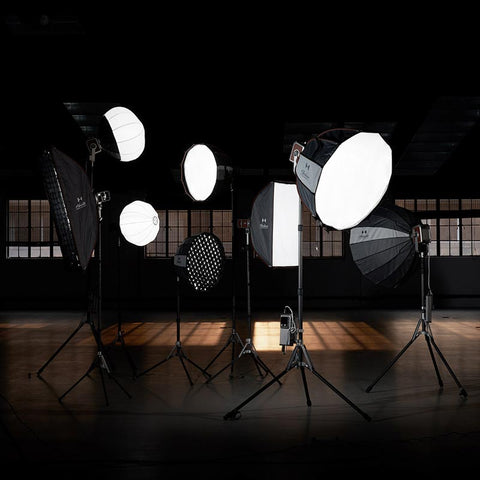
Smaller lights provide subtle fill when natural light fades or becomes uneven. Medium-sized portable lights allow quick portrait setups or moving subjects. Larger units with modifiers support more structured compositions when the environment allows it.
This layered approach mirrors the unpredictability of travel assignments. A photographer may move from daylight markets to dim interiors to night scenes within a single day. Each situation calls for a different scale of light.
Portable LED lighting systems have made this flexibility far easier to achieve.

Why Harlowe Fits
Harlowe lights have found a place in many travel and editorial photographers’ kits because they combine several qualities that are difficult to achieve simultaneously: portability, power, and intuitive control.
For a photographer like Ira Block, those characteristics matter.
Compact lights can travel easily and still provide enough illumination to augment natural light when necessary. Adjustable output and color temperature allow artificial light to blend more seamlessly with existing conditions. Modifiers expand creative possibilities without adding excessive weight or complexity.


- Prezzo di listino
- Prezzo di vendita
- Da €678,19
The result is a lighting system that adapts to different environments rather than forcing the photographer to adapt to the equipment.
Modern photography increasingly spans multiple formats—still images, video interviews, educational workshops, and documentary storytelling. A portable lighting system capable of moving across these contexts supports a more fluid creative process.
Harlowe’s design responds to that reality.
Teaching Photographers to See
Block’s workshops often return to one fundamental idea: photographers must learn to see light the way the camera sees it.
Human vision automatically adjusts brightness and contrast. Cameras do not. This difference can surprise beginners who expect their photographs to match what they saw with their eyes.
Understanding light means learning how it behaves within the camera’s frame. Direction, softness, intensity, and shadow all influence how a photograph feels.
Time of day becomes especially important. Early morning and late afternoon light provide direction and softness that can transform a portrait or landscape. Midday light, by contrast, often requires more careful positioning.
Artificial lighting builds on the same principles. The more a photographer understands natural light, the more effectively they can shape light in controlled situations.
Light as an Emotional Tool
Some of the most memorable images in Block’s career illustrate the emotional power of even modest lighting adjustments.
A temple interior illuminated by candlelight may carry profound atmosphere but still require a subtle additional source to reveal the subject clearly. A small portable light can introduce just enough illumination to bring a face forward without altering the mood.
Moments like these reveal an essential truth about photography lighting: the scale of the equipment matters less than the photographer’s understanding of light itself.
Once that understanding exists, almost any light source becomes usable.
Portable lighting simply offers consistency and control when the photographer needs it most.
The Enduring Lesson
Across decades of travel and storytelling, Ira Block’s photographs have maintained a consistent intention: to help viewers see other people with clarity and empathy.
Light plays a quiet but powerful role in that effort.
It guides the viewer’s attention. It shapes emotional tone. It transforms observation into connection.
In an era when images circulate at extraordinary speed, the photographs that endure often share a similar quality—they invite the viewer to pause.
Ira Block’s work continues to do exactly that.
And in those images, light remains the element that makes the invitation possible.
FAQ
What is the best lighting for documentary photography?
Natural light is typically preferred in documentary photography for its authenticity, but portable LED lights can be used to subtly enhance visibility without disrupting the scene.
How do photographers use lighting in travel documentaries?
Travel photographers often rely on lightweight, portable lighting to adapt quickly to changing environments while maintaining a natural look.
Do documentary photographers use artificial light?
Yes, but usually in a minimal and controlled way to support the existing light rather than overpower it.


