
Every creator has a sentence they say out loud at the end of a long day. Some version of: I should have brought the tripod.
It isn't that they didn't think about it. They thought about it the night before, in the order they always do — body, lenses, batteries, cards, a light, a mic, the tripod. Then they did the math the tripod always loses. Too big to fit. Too heavy to carry. The head sold separately because the head was always sold separately. And so the tripod stayed home, and the day got made without it.
Rocket Air exists for the bag that has stopped making that calculation.
One kilogram is the negotiation.

The whole conversation about travel tripods, in the end, is a conversation about one kilogram.
One kilogram is the line where a tripod stops being a thing you carry and starts being a thing you reconsider. A full-size support system sits on the wrong side of that line and pays for the wrong side in pack weight every day. A pocket tabletop sits below the line and pays for it in capability — no real height, no real damping, no real shot.
Rocket Air, with the fluid head attached, weighs 1 kg / 2.2 lb. Folded with the head on, it's 19.7 inches — about the length of a folded jacket. Folded without it, 16.1 inches. The case is shaped like a thermos. Nothing about it has to be argued with on the way out the door.
The negotiation is over. The tripod comes.
The head you already wanted is the head you already have.

The other reason the tripod gets left behind is the head. A working video tripod usually arrives as two purchases — a set of legs, then a fluid head that costs as much again and brings the package back over five pounds. Photographers can get away with a ball head. Anyone who shoots video can't, and so the rig the photographer carries isn't the rig the hybrid creator needs.
Rocket Air ships with its fluid head already on. Smooth hydraulic damping for both pan and tilt, the kind of motion that lets a slow B-roll move look like a slow B-roll move instead of a deliberate flinch. The head tilts +90° to -55° vertically and ±10° laterally. It detaches in a turn when the shot calls for a different mount. There is no separate purchase. There is no second decision.
It's also a quiet acknowledgment of something the category took a long time to accept. The creator who used to be a photographer is now also a videographer, and the support they carry has to be both.
The kit that doesn't fight you.

Anyone who's spent time on a creator forum knows the recurring frustration: the quick-release plate from one brand doesn't speak to the camera clip from another, and the work of switching between shots becomes a tax paid in seconds, every shot, all day. Compatibility is the silent friction of a multi-piece kit.
Rocket Air is built to disappear into the workflow already on you. The fluid head uses a universal mount interface, designed to play with the quick-release systems creators already trust. When the head comes off, the top of the center column reveals a dual 1/4-inch and 3/8-inch stud — the two standards almost every camera, light, monitor, and microphone in the working kit is built around. The tripod becomes whatever the moment needs it to be.
And the moment usually needs more than one. The two 1/4-inch threaded ports on the side of the leg assembly are there for the second thing — the field monitor for the interview, the wireless audio receiver for the BTS, the recorder for the sit-down. A one-person video setup that used to require two stands now requires one.
Three seconds, three positions, one weight.

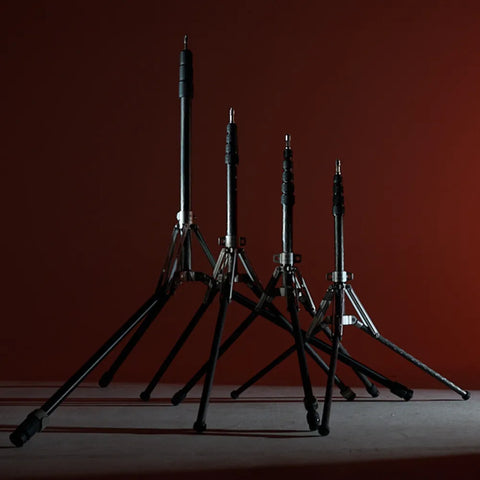
The tripod opens with a single twist-lock motion in under three seconds. Four leg sections, locked at any height the shot needs. A three-position press-buckle leg spread that lets the legs sit standard, mid, or flat — the third position is the difference between getting a low-angle product shot and giving up on it.
The legs are high-density carbon fiber. The head and joints are machined from aerospace-grade aluminum, anodized in Harlowe's silver and champagne gold — a finish that signals what the tripod is doing on a client-facing set without saying anything. There is a center column hook for a counterweight when the wind picks up at a coastal shoot. The tripod is rated to 22.05 pounds; the head holds 6.61. Both numbers are more than any mirrorless creator rig that fits inside the bag.
The work doesn't wait.
The argument for a travel tripod has always been the same one. The work doesn't wait for the gear to arrive. The light doesn't hold while a head gets unscrewed and a head gets screwed on. The interview subject doesn't sit longer because the kit took an extra minute. Every second between the idea and the frame is a second the creator is paying for.
Rocket Air is built for the second to be returned. The bag is lighter. The setup is shorter. The head is already on. The accessories that used to need their own stands now share this one. Travel light without compromise has always been a marketing line. Here it's a measurement: 1 kg / 2.2 lb, 19.7 inches, under three seconds, one kit.
If you are ready to turn the carry decision into a working setup, read How to Build a Lightweight Creator Setup With Rocket Air. This article explains why Rocket Air earns its place in the bag; the setup guide shows how to use it across camera, tabletop, light, audio, and mobile workflows.
Light built to be trusted. Support built to be brought.


