
Softboxes are often framed as the “professional” upgrade. Bare LED panels get labeled the beginner option.
But once we’ve built a real studio lighting setup inside an actual room, not a showroom, that comparison starts to fall apart. Neither modifier is automatically better. They solve different problems.
Softbox lighting can smooth skin, soften shadow edges, and give a scene a polished feel. At the same time, it can reduce output, flatten contrast, and spill light into areas we didn’t intend to brighten. A bare studio light can add punch and definition, but it can look harsh if we don’t control it properly.
In this blog, we’re breaking down the real difference between softbox lighting and bare LED panels, not in a showroom, but in the kind of tight, real-world creator rooms where spill, output loss, and “why does my background look washed?” actually happen.
What Diffusion Actually Does
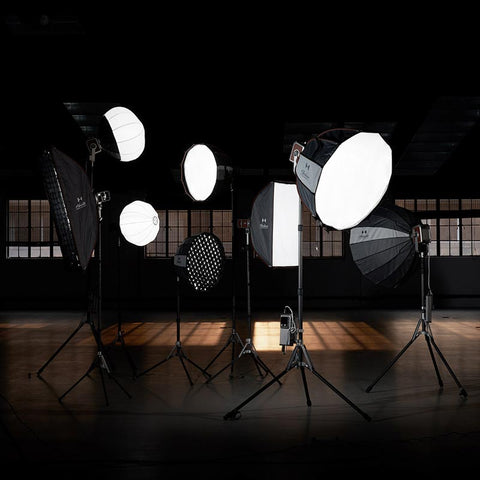
Before choosing between a softbox and a bare panel, it helps to understand what diffusion changes. When you add a softbox, you increase the apparent size of the light source. A larger source produces softer transitions between light and shadow. Edges blend gradually instead of cutting sharply across a face or wall.
But softness isn’t the only effect.
Diffusion spreads light. It lowers contrast. It absorbs some intensity. In smaller creator studios, that spread can brighten walls and ceilings we intended to keep darker.
Most debates over softbox lighting vs bare panels aren’t really about softness. They’re about control over spill, separation, highlight size, and exposure balance.
Diffusion is a shaping tool. It changes more than the shadow texture.
Softbox Lighting: When Diffusion Helps
There are situations where softbox lighting simply makes the setup easier and more forgiving, especially when we’re lighting people.
Use A Softbox When The Subject Is A Face
Faces rarely benefit from direct, hard light. Softer shadow edges reduce under-eye contrast and smooth highlight roll-off across the forehead and cheeks.
For tutorials, interviews, livestreams, and talking-head content, a diffused key gives us a reliable starting point. It minimizes “surprises” on skin and helps maintain consistency across shoots.
That’s why many creator-focused photography lighting kit setups include at least one diffusion option.
Use A Softbox When You Want Even Light Without Looking Flat
In educational content, clarity often matters more than drama.
Softboxes reduce harsh shadow lines on walls, especially in small rooms where photoshoot lighting can feel cramped. With thoughtful placement slightly off-axis and elevated, we can maintain shape without overwhelming contrast.
Soft doesn’t mean shapeless. It just requires positioning with intention.
Use A Softbox As A Subtle Fill
When lifting shadows, we don’t always want a second dominant light direction.
A lower-powered softbox can act as fill without creating additional sharp shadows. It keeps the scene balanced and controlled.
Use A Softbox For Matte Products And Top-Down Setups
For packaging, paper, fabric, and food styling, even coverage matters. Softbox lighting spreads more evenly across surfaces, reducing tiny LED hotspots that sometimes appear with a bare studio light.
For non-reflective products, diffusion often simplifies the process.
When Softbox Diffusion Hurts
Diffusion helps until it starts solving the wrong problem.
The first thing we usually notice is reduced output. If our studio light was already working hard, heavy diffusion can push us toward higher ISO or less flexible angles.
Large soft sources can also flatten a scene. When shadows fill in too much, the subject and background begin to sit at similar brightness levels. Depth disappears.
Spill becomes another issue in small rooms. Soft light spreads quickly, and the “moody corner” we liked turns evenly lit.
Diffusion works best when smooth transitions are the goal. It works against us when we need brightness, contrast, or tight control.
Bare LED Panels (No Softbox): When They Win

Here, ‘bare’ means a panel like the Harlowe Sol 100 used without a softbox or diffusion. Softboxes spread light and soften edges; an unmodified panel keeps the beam more direct and defined. That shift changes how we build a lighting setup.
Use An Unmodified Panel When You Need Punch In A Small Space
Without modifiers absorbing output, a panel without diffusion delivers more usable brightness per watt.. Exposure stays manageable without pushing camera settings too far.
Use An Unmodified Panel (No Softbox) When You Want Shape And Contrast
Harder light introduces stronger edge definition. Jawlines, clothing folds, and product contours gain structure.
If softbox lighting makes everything feel overly safe, a bare panel can reintroduce dimension.
Use An Unmodified Panel For Background And Accent Work
Background gradients, rim lighting, and shelf highlights benefit from precision. Bare panels are easier to aim and easier to contain with simple positioning adjustments.
Use An Unmodified Panel Without Diffusion When You’re Bouncing Light
An unmodified panel aimed at a wall or ceiling can become a large, soft source. Depending on surface color and distance, bounce can feel more natural than a small softbox.
Bare panels often win on efficiency and control.
The Real Answer: Treat Diffusion Like A Dial, Not A Switch

We don’t have to commit to one modifier permanently. Most strong creator setups combine both approaches.
We can feather a softbox slightly past the subject to reduce spill. We can use lighter diffusion instead of heavy layers. We can add a grid to keep softness while tightening the spread.
A practical hybrid approach looks like this:
-
Soft key for the face.
-
Unmodified (no softbox) or lightly diffused panel for separation or background depth.
This keeps the subject flattering while preserving the scene’s structure.
Quick Troubleshooting: What You See and What To Change First
Even strong setups need adjustment.
-
Skin Looks Harsh: Add diffusion or bounce; move the light closer before lowering intensity.
-
Image Looks Flat: Reduce fill, add negative fill, or darken the background.
-
Background Too Bright: Feather the light or increase the subject-to-wall distance.
-
Glass Reflections Persist: Raise the light and shift it off-axis.
-
Product Highlight Looks Messy: Experiment between larger soft sources and smaller controlled ones.
Small shifts often fix what feels like a major issue.
Dial In Your Light, Don’t Just Soften It
Softbox lighting is not automatically more professional, and bare panels are not automatically harsh. What looks “pro” is control. Decide what the shot needs first: smoother skin and gentler transitions, or tighter contrast and cleaner separation. Then treat diffusion like a dial: start with bounce, add light diffusion when needed, and go full softbox only when it solves a specific problem.
If you want a setup that can swing between soft and punchy without rebuilding your whole scene, explore Harlowe’s Light Modifiers.


